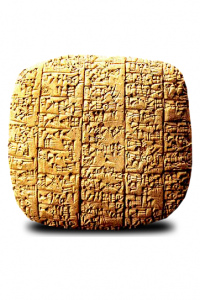
| The Ebla Tablets |
|
In order to cast light on this: the term Elohim is a Hebrew word used by Jews and priests; they use this word to name God, but Elohim would be His plural: gods. In the original Bible, the Hebrew one, they do not talk about a single god but about gods... the Elohim. Later this word started to be used in singular, "god", when the monotheistic religion was unified - that is, the religion which worships a single god. Now we know that the Enuma Elish is a summary of legends of Sumerian origin, as it would happen with the Babylonian beliefs; it seems to be a history about the birth of our Solar System. The Enuma Elish was written in seven tablets, and the biblical Genesis takes place in seven days. God rested on the seventh day of the Genesis, and the seventh tablet of the Enuma Elish is an appreciation of the work of their god. It narrates the construction of Babilum ("Archade of the gods", Babylon) and a ziggurat dedicated to Marduk, but supposedly it was dedicated to Enlil; in the Bible they tell us about the "Tower of Babel". The samples are countless. The chaos, the abyss over the water, or "Tehom", was named Tiamat in the Enuma Elish, and was the monster which represented the chaos. Most of the biblical stories and characters are based on stories of Sumerian origin. In this way, the first ten biblical patriarchs are the same as the Sumerian antediluvian kings. Among the ten antediluvian kings we can find Alulim, who was "he who spread the seed" (Adam), his son Alalgar (Set), and others like the shepherd Dumuzid, who was murdered (Abel); Enmenduranna (who knew the secrets of the skies: Enoch); Enmengalanna (who knew how to obtain the mediation of the gods, like Enos and his praying); the already mentioned Ziusudra (Noah) and his father Ubar-Tutu (Lamech). In Sumer it was the gods who decided the destruction of man because of his meanness, as in Genesis, but only one of them (Enki) took pity on humankind, and he ordered one man to build a ship and fill it with animals. The Universal Deluge is the name of a Sumerian legend and, later, the name by which we know an event narrated in the Genesis, first book of the Bible, about the story of Noah and the punishment sent by God. If texts like those of the Bible are copies of ancient Sumerian texts, we can say that they were inherited from the Babylonian period, so they are pagan beliefs supported by polytheism. There is a Sumerian text that is usually named the Poem of Gilgamesh. It is a narration from Mesopotamia of Sumerian origin, considered the oldest narration in History. They used clay tablets and cuneiform script, which favoured its preservation. According to the Sumerian King List, Gilgamesh was the fifth king of Uruk. The poem tells the adventures of King Gilgamesh, also known as Istubar, and his friend Enkidu in their search for immortality. One of the tablets speaks of a chapter very similar to the one in the Bible about the flood. It also mentions a series of details very similar to those we can find in the Bible, like the Cherubim which guarded the access to the "tree of life". |

|